

Dreams: Part 3
The Origin of Dreams & the Great Mother of All

Exordium
This may sound oxymoronic, but the concept of magic tends to be over-mystified in today’s world. Magic is simply the act of making seen what was once unseen, or materializing the immaterial. Humanity does this almost effortlessly through manifestation, which is totally comprised of procreation and innovation. When a child is born, it goes from unseen to seen; from immaterial to material. When there’s an invention, it goes from unseen to seen; from immaterial to material. Now, with that said, consider this: The word ‘imagination’ comes from the word ‘image’—the word ‘image’ comes from the word ‘mage’—and the word ‘mage’ means ‘magic’. This is not semantics, but correlation, because every tangible thing began with an intangible thought.
But, what makes humanity so special? Mammals also have an imagination; they dream, procreate, and some even have the ability to invent tools. Why then have human beings ascended to such heights with seemingly limitless access to the imagination? The simple answer is extremism. Humans are inherently extreme, yet when it comes to curiosity something extremely magical happens.
Piercing the Veil
Curiosity is what grants entry into the imagination, because anything that has the capacity for curiosity also has the capacity to imagine. This allows the creature to fill the mental blind spots that aroused its curiosity. However, curiosity exists on a spectrum, with ponderment on one end and lust on the other. The animal kingdom is generally neutral in this regard. They ponder, but not deeply; lust, but not deeply, and the imagination responds by yielding only the shallowest portions of her jurisdictions to them. This is why animals do not manifest on a large scale, creating nothing that endures over time, and having a relatively low threshold for sexual deviance.
Does this imply that limitless access to the imagination brings about sexual deviance? It is plausible. You see, extremism has always been a gift and a curse for humanity. Extreme curiosity allows it to ponder and lust deeply. While this can lead to unparalleled knowledge, thoughts, and ideas, it also exposes humanity to the deep and dark depths of the imagination. So, sexual deviance is sort of a byproduct. Nevertheless, these conditions are humanity’s birthright; it was meant to be a gift and a curse because duality is part of godhood—a godhood that was pre-ordained in the beginning. Yes, the Biblical beginning.
The Biblical Beginning
Despite common Christian beliefs, the Bible should not be seen through a historical lens. What the book of Genesis refers to as “the beginning” isn’t literal; rather, it marks the time when humanity began to transcend the boundaries of the natural world in order to peer into the supernatural. In simpler terms, the Biblical beginning signifies the moment when humanity first became conscious, self aware, and enlightened.
You see, there was a time when animals and humans were on par in mind, behavior, and even stature to some degree. Science often refers to this period as the prehistoric era. Little to nothing was documented during this time because humanity was in its infancy: uncivilized, and in a state of stupor. The initial chapters of the book of Genesis align with this timeframe. It details how humanity evolved from this primal state and into civility through the invention of tools and weaponry. Essentially, humanity rose above the animals and became gods on earth through harnessing the power of the imagination.
The Book of Genesis From an Esoteric Lens
It is imperative to understand that many Biblical figures—especially those prior to Abraham—were not individual humans but rather titles, parables, and metaphors for entire communities, generations, and dispensations. This is why the lifespans before Abraham were described as extraordinarily long, such as Adam, who is said to have lived for over nine-hundred years. A single human could never live that long, but entire communities, generations, and dispensations definitely can. Consider the Kong family of China for example. It is speculated that they have survived for over two-thousand years, yet there isn’t a single member thereof who is actually that old.
This also applies to Cain and Abel. Humanity’s first culture was agriculture, and Cain and Abel represent its fundamental components: crops (Cain), and livestock (Abel). Then, as resources began to increase, so did conflicts over those resources, leading to wars and ultimately murder. The Bible had simply reduced thousands, or even millions of years of human behavior—which still exists—into a parable about two brothers with agricultural vocations.
Now, consider this: “In the beginning God created the heavens and the earth. And the earth was without form, and void; and darkness was upon the face of the deep. And God said, Let there be light: and there was light” (Genesis 1:1-3). Notice that throughout all of this, God spoke only once. His first words were, “Let there be light.” Keep this in mind.
The previous verses are multidimensional. This means they simultaneously carry physical, mental, and spiritual meanings and applications. “Let there be light” represents humanity’s discovery of fire, one of the earliest signs of the species’ propensity for extreme curiosity. This discovery was a major catalyst for human innovation, sparking a renaissance of new and improved tools and weaponry. The discovery of fire was also a multidimensional shift; it not only brought humanity out of physical darkness, but also mental darkness, as mankind had effectively progressed out of infancy.
The term “infant” means unable to speak, which is why God’s first words were, “Let there be light”. However, Adam and Eve brings it all full circle.
The Garden of Eden
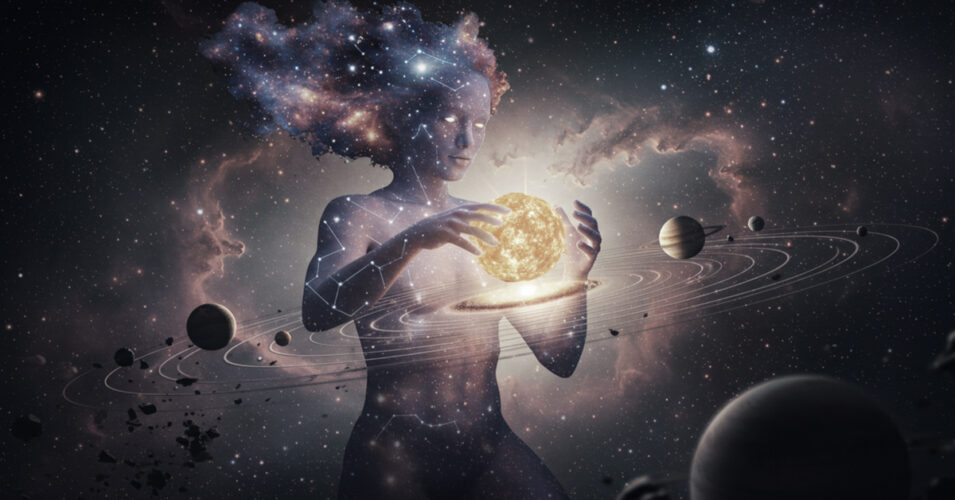
The latest entry in this series states that mankind is the father of all inventions, imagination is its mother, and necessity is its God. The story of the Garden of Eden encapsulates this idea. Adam symbolizes mankind, Eve symbolizes imagination, and God symbolizes necessity. How is this for certain? Consider the fact that God placed Adam into a deep sleep, but it never specifies when or if He ever woke him up. Therefore, Adam encountered the woman—who was nameless at the time—while he was asleep, within a dream.
Now, recall the fact that the word “imagination” ultimately means magic. The tree of knowledge of good and evil symbolizes its two factions: black magic and white magic. Furthermore, the serpent being described as crafty is also an allusion to magic, hence to the word “witchcraft”.
After Adam and the woman ate from the tree of knowledge of good and evil, the scriptures say that their eyes were opened (Genesis 3:7), which signifies that Adam had finally awakened from his slumber, and mankind had become conscious. Upon this awakening, Adam began to call the woman Eve, which means “mother of all living” (Genesis 3:20). This signifies that the entire ordeal caused her to become pregnant. The onus was placed onto Eve—not because she was more complicit, guilty, or evil—but simply because pregnancy is a burden. And whether it is an invention or procreation—animate or inanimate—the feminine component is responsible for ensuring its transition from darkness to light.
In Closing
All in all, the events that took place in the Garden of Eden should not be viewed as an unexpected tragedy, a negative portrayal of women, or a distant standard that humans are cursed to pursue. These things were meant to happen, because humanity—and subsequently the world—could not have developed any other way. In fact, this moment was so galvanizing that its impact resonates throughout existence to this day.
You see, while in the womb, the human creature endures a state of perpetual unconsciousness—sleeping, dreaming, and essentially dead to the physical world while alive to the imagination. That is its Garden of Eden, a place of bliss and tranquility where it frolics alongside a nameless woman. When the time comes, the human is expelled from the womb and awakens from this dream realizing that the nameless woman is its mother. And just as Eve taught Adam, which helped progress and civilize humanity, mothers serve as the first teachers for every living being. They take their naked and ignorant infant—who drools, babbles, and crawls like an animal—and then progress and civilize it with knowledge. From that point onward, whenever the creature falls asleep, it temporarily returns to that state of unconsciousness, and back into Eve’s bosom—the imagination, the origin of all things.
More Articles